European Coffee Trip: Coffee + mobile app = ♥
The creation of the European Coffee Trip mobile app brought together a real user problem, our love of coffee, and — unfortunately — Covid. What seemed unrealistic in 2020 is now an app used by a quarter of a million users.
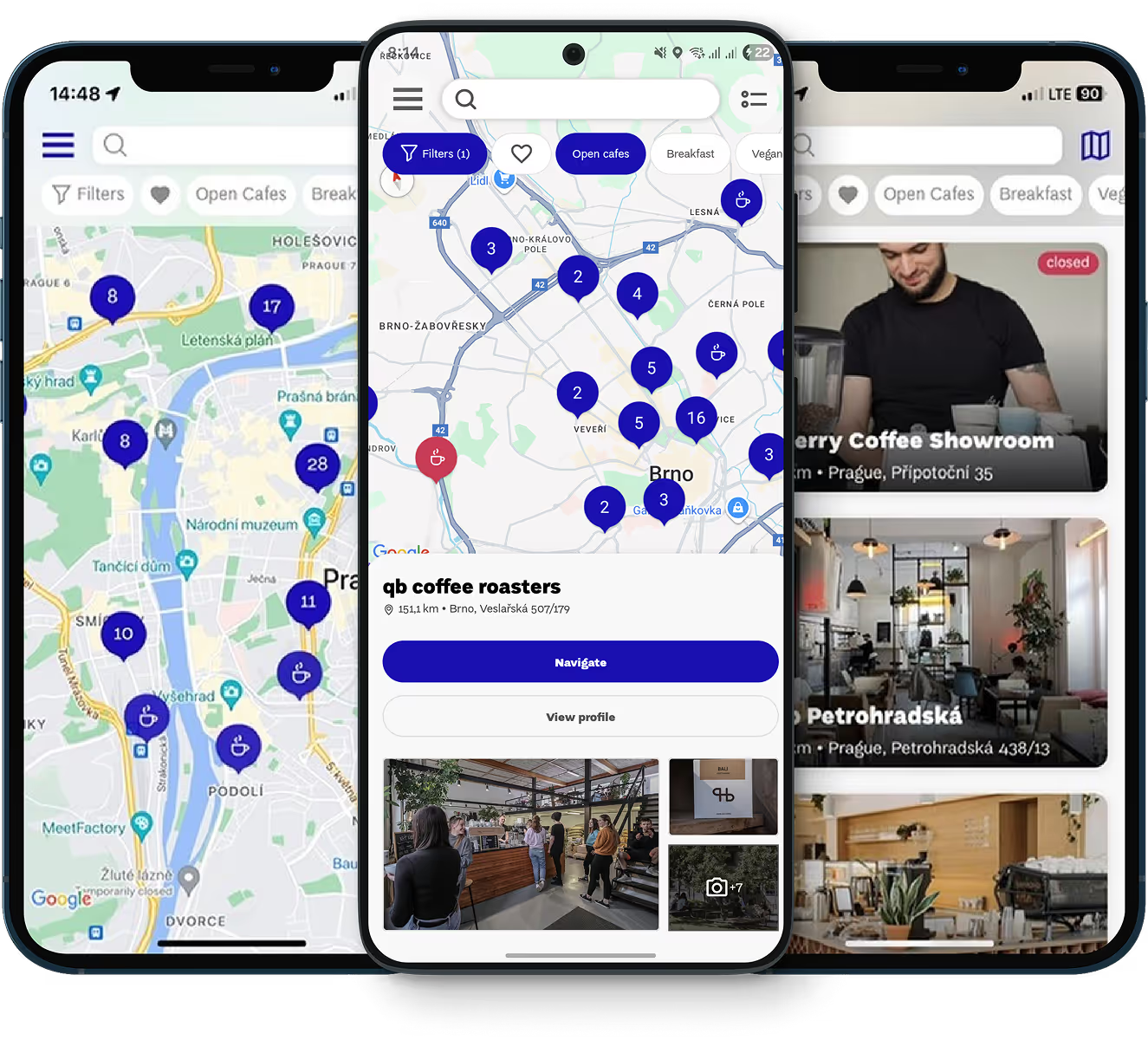
As the saying goes, great minds think alike. It was no coincidence that one of our founders reached out to the European Coffee Trip team just as they were considering a mobile app. At the end of 2019, we decided to join forces and began working on the iOS version first, followed by Android. But since ECT is based on discovering new places, the travel bans and lockdowns caused by Covid led to a development pause. We finally launched the first version of the app on September 30, 2021.
„Since our first coffee trip across Europe, we'd been dreaming of the day we could offer European Coffee Trip as a mobile app. Thanks to Cookielab, this dream came true — and we've also found a partner who continues to move the app forward with us, actively seeking the best technical and business solutions.“
The story
Our task was to translate the cafe map into a mobile app with minimal changes to the CMS where ECT manages its database. The goal was to simplify the app as much as possible, keep file size small, and make it lightning-fast. We also wanted users to be able to search for cafes offline, for example, on a flight with no Wi-Fi.
Statistics showed that the majority of users were on iOS, so we strategically split the development into two phases. We started with the iOS version, where we also prototyped, refined the design, and tackled technical challenges, including a simple monetization system. Once that was polished, we began developing the Android version. Thanks to the work done during the iOS phase, we finished Android development in half the time.
In the four years since launch, we've added lots of improvements to the app, from better map visuals to increased cafe visibility and more advanced filtering. In 2024, we launched a user vote for the most popular cafe. We recently launched push notifications and we're now exploring ways to connect roasteries to the map.
The challenges
The biggest challenge was keeping the app as simple as possible while delivering a rich experience. Covid lockdowns in 2020 forced a development pause since ECT is based on discovering new places. We had to strategically split iOS and Android development to maximize efficiency.
What's next
We're working on better automation, like syncing cafe opening hours with Google automatically. We plan to introduce notifications for competitions and explore ways to integrate roasteries into the map, giving the coffee community even more content and insight.
As the saying goes, great minds think alike. It was no coincidence that one of our founders reached out to the European Coffee Trip team just as they were considering a mobile app. At the end of 2019, we decided to join forces and began working on the iOS version first, followed by Android. But since ECT is based on discovering new places, the travel bans and lockdowns caused by Covid led to a development pause. We finally launched the first version of the app on September 30, 2021.
What we delivered
„The biggest challenge was making the app as simple as possible. From the start, we used basic technologies like cached JSON data. It saved us and the client a lot of work, and it shows in the app's reliability.“
Technologies
The story
Our task was to bring the existing web cafe map into a mobile app with minimal changes to the CMS. We began by researching whether to build multiplatform (Flutter) or natively. We concluded that native development made more sense, as Flutter was still in its early stages.
We aimed to minimize data usage and ensure users could search for cafes offline. We kept the app architecture simple and relied on modern device performance. Everything runs through RAM without a database or unnecessary APIs, making the ECT app simple, fast, and reliable.
We wrote the iOS app natively in Swift, using Xcode Cloud for building and Firebase for analytics, push notifications, and remote configuration. The Android version benefited from the finalized architecture, and using Jetpack Compose, we achieved 50% faster development time. We don't really deal with a backend — the app pulls data from a static CDN. Thanks to our approach, we're able to render around 5,000 cafes in just 772 ms.
For detailed cross-platform analytics, we connected Firebase Analytics (mobile) with Google Analytics (web) through BigQuery, giving both cafes and the ECT team access to detailed profile visit and click-through stats without paying for third-party analytics tools.
What's next
We're now working on better automation, like syncing cafe opening hours with Google automatically. In the future, we plan to introduce notifications and explore ways to integrate roasteries into the map, giving the coffee community even more content and insight.