Eat Smart: Partnership in the development of a brand-new IoT device
Perfect Canteen conceived the idea of an innovative smart refrigerator for dispensing boxed meals. We devised the entire technical infrastructure, from hardware integration to the mobile app.
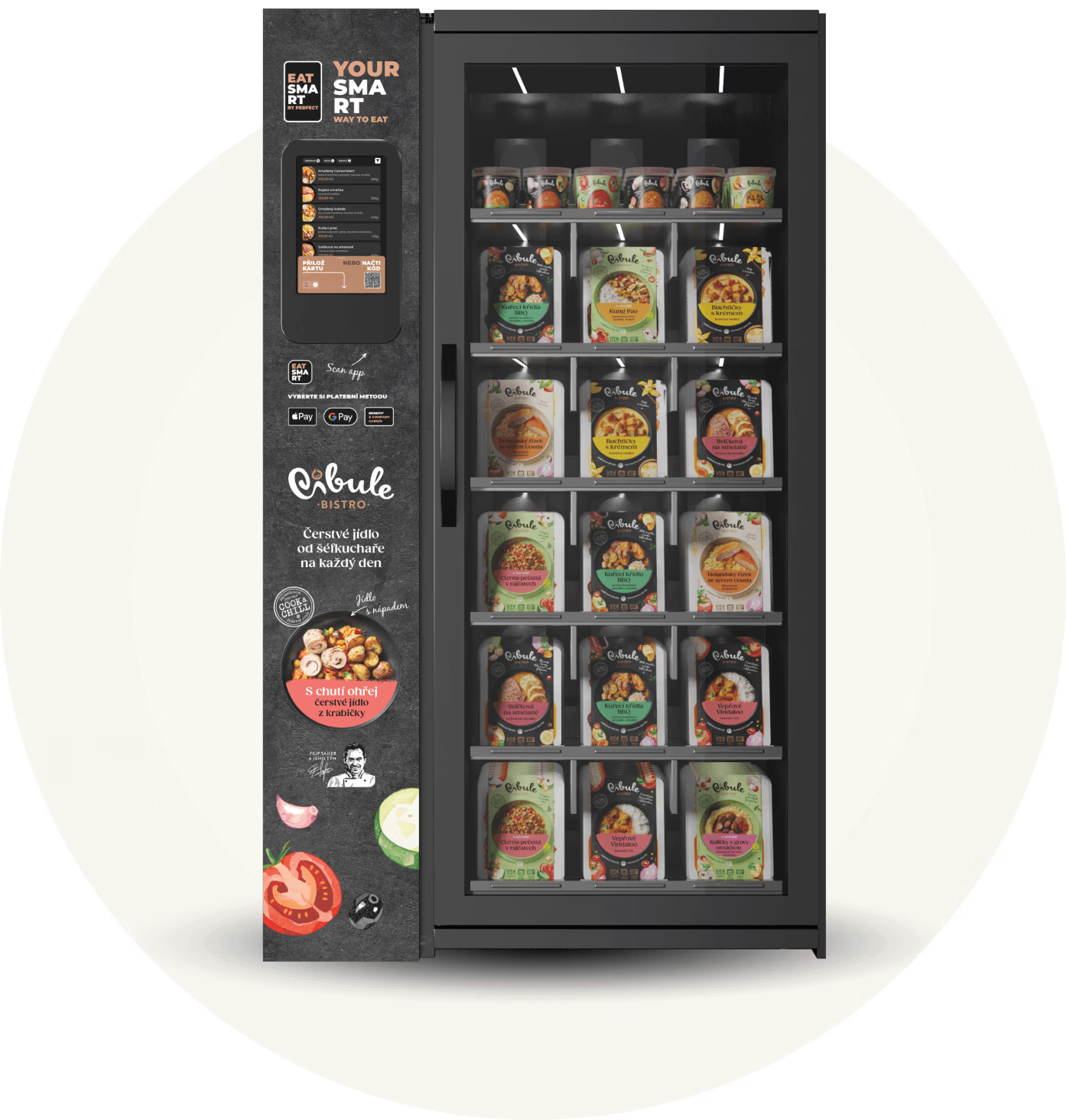
At Perfect Canteen, you can purchase lunch worry-free. You simply enter, scan your access, grab your lunch, and depart. The EatSmart refrigerator automatically identifies the items taken and forwards the information. It fell upon us to devise the entire technical infrastructure, from integrating all the hardware to developing the mobile application.
„If it weren't for Cookielab, we might have scrapped the project long ago. But Radek, Kolda and their team have partnered up with us to push the product forward. They don't shy away from challenges and they understand that cooperation isn't only about development, but also about presenting to investors.“
The story
The founder, Filip Sajler, had a vision: businesses could use a smart fridge to find great restaurant-quality food — without canteens and the worry of payment. This meant developing a globally unique solution, because classic vending machines did not make economic or operational sense.
We threw ourselves into Product Discovery, where we defined the problem, priorities, and a roadmap. Within three months, we had to present a working proof of concept to management. We assembled a wooden prototype and set up communication between IoT elements while developing the application.
The refrigerator automatically recognizes stored food thanks to RFID tags. When picking up food, employees place their card next to the refrigerator or scan a QR code. Users can filter by allergens, and the fridge lights up where their food is. The whole process takes seconds — the slowest purchases take 15 seconds.
However, after initial prototyping, the technology didn't work reliably in a real environment. Metal elements reflected our signal, graphite in black paint was electrically conductive, and adhesives caused problems. We found a solution through German RFID expert Olaf Wilmsmeier's LOCFIELD RFID UHF antennas — our 'Eureka!' moment.
The challenges
The collision with the laws of physics was the biggest challenge. After initial prototyping, we thought we had solved reliable chip reading, but the technology failed in a real environment. Metal reflected signals, graphite in paint was conductive, and adhesives caused interference. We had to start from scratch with new LOCFIELD RFID UHF antennas.
What's next
By April 2025, 100 EAT SMART refrigerators should be distributed in the Czech Republic. Perfect Canteen's vision that every company will be able to afford restaurant-quality food for their people — even in industrial halls or 24/7 — is taking shape. We also added Apple Pay and Google Pay for convenience.
At Perfect Canteen, you can purchase lunch worry-free. You simply enter, scan your access, grab your lunch, and depart. The EatSmart refrigerator automatically identifies the items taken and forwards the information. It fell upon us to devise the entire technical infrastructure, from integrating all the hardware to developing the mobile application.
What we delivered
„If it weren't for Cookielab, we might have scrapped the project long ago. But Radek, Kolda and their team have partnered up with us to push the product forward. They don't shy away from challenges and they understand that cooperation isn't only about development, but also about presenting to investors.“
Technologies
The story
We started with Product Discovery to define the problem and validate technical feasibility. Within three months, we delivered a proof of concept. The alpha and omega was creating a system for purchases without a payment terminal.
The refrigerator uses RFID tags on boxes for automatic recognition. Restocking takes only 1.5 minutes. The system handles employee authentication, allergen filtering, position detection within the fridge, automatic locking, payroll integration, and inventory notifications.
The initial RFID technology failed in the real environment — metal elements reflected and attenuated our signal, graphite in black paint was electrically conductive, and adhesives caused interference. We discovered LOCFIELD RFID UHF antennas by German expert Olaf Wilmsmeier, which solved everything. We restarted integration from scratch.
In the pilot operation, we learned that those who produce and pack the food must cooperate — RFID tags must match the food and be positioned correctly for antenna readability.
What's next
By April 2025, 100 EAT SMART refrigerators should be distributed across Czech companies. We continue developing the hardware-software integration and expanding the mobile application capabilities.