Eat Smart: A smart fridge instead of a company canteen
Chef Filip Sajler and HOPI Holding wanted to bring restaurant-quality food into companies without building canteens. We built the entire technology from scratch – RFID recognition, mobile app, cloud. Today the network runs on 80 locations and sold 312,000 portions in 2025.
Eat Smart
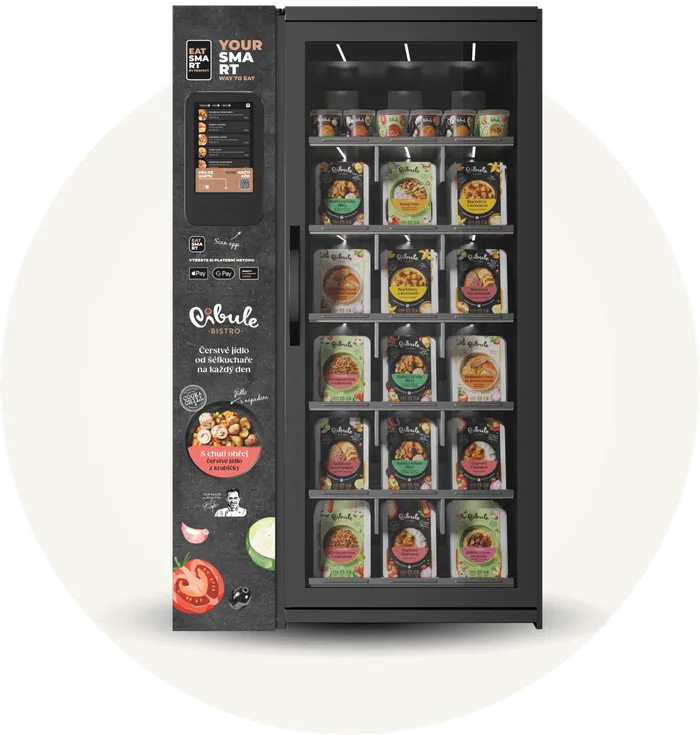
EAT SMART answers a question almost every company asks: how to feed employees quality food without building and running an expensive canteen. Chef Filip Sajler and HOPI Holding came up with a self-service smart fridge stocked with fresh chef-made meals. We supplied the technology behind the idea – a complete ecosystem from hardware through mobile app to cloud that turns the whole grab-and-go moment into a 15-second purchase.
What we delivered

“If it weren't for Cookielab, we might have scrapped the project long ago. But Radek, Kolda and their team have partnered up with us to push the product forward. They don't shy away from challenges and they understand that cooperation isn't only about development, but also about things like presenting to investors. In hindsight, I'm really glad I trusted the recommendations and my impression from the first meeting. The professionalism, insight and friendly approach of the people at Cookielab are exactly what a person is looking for in their developers.”
Challenge: Find hardware and software solutions
Filip Sajler and HOPI Holding are no newcomers to corporate dining – they had already built a canteen network and sold it to the American group Aramark. With EAT SMART they set a more ambitious goal: workplace dining that scales without chefs and staff on site. Instead of tens of millions of crowns for building a canteen and millions more each month to run one, a company gets a smart fridge for tens of thousands of crowns a month – up to 90% lower investment and 75% lower operating costs.
This was never a pure software project. It combines physical hardware, fresh food with a short shelf life, and software that has to run reliably 24/7. The hardest fight was RFID itself: the chips initially failed because metal parts of the fridge and the conductive black paint interfered with the signal. For a while it looked like physics might win. Fixing it meant completely re-engineering the reading array around specialized LOCFIELD UHF antennas.

Product Discovery: First results within 3 months
Using a template is meaningless when dealing with a completely new product. Therefore, we first threw ourselves into the so-called Product Discovery phase, during which we define the problem we are trying to solve, priorities for development, and a roadmap for the future of the product. In this phase we also validate the technical feasibility.
With EAT SMART, we needed to present a working technology (proof of concept) to management within three months. The alpha and omega was to create a system that allowed for the purchase to take place as quickly as possible and without the need for a payment terminal.
We assembled a wooden prototype and set up communication between individual IoT elements while our development team focused on developing the application. We started with a pilot at the HOPI campus at the end of 2023; the first live launch came in January 2024.
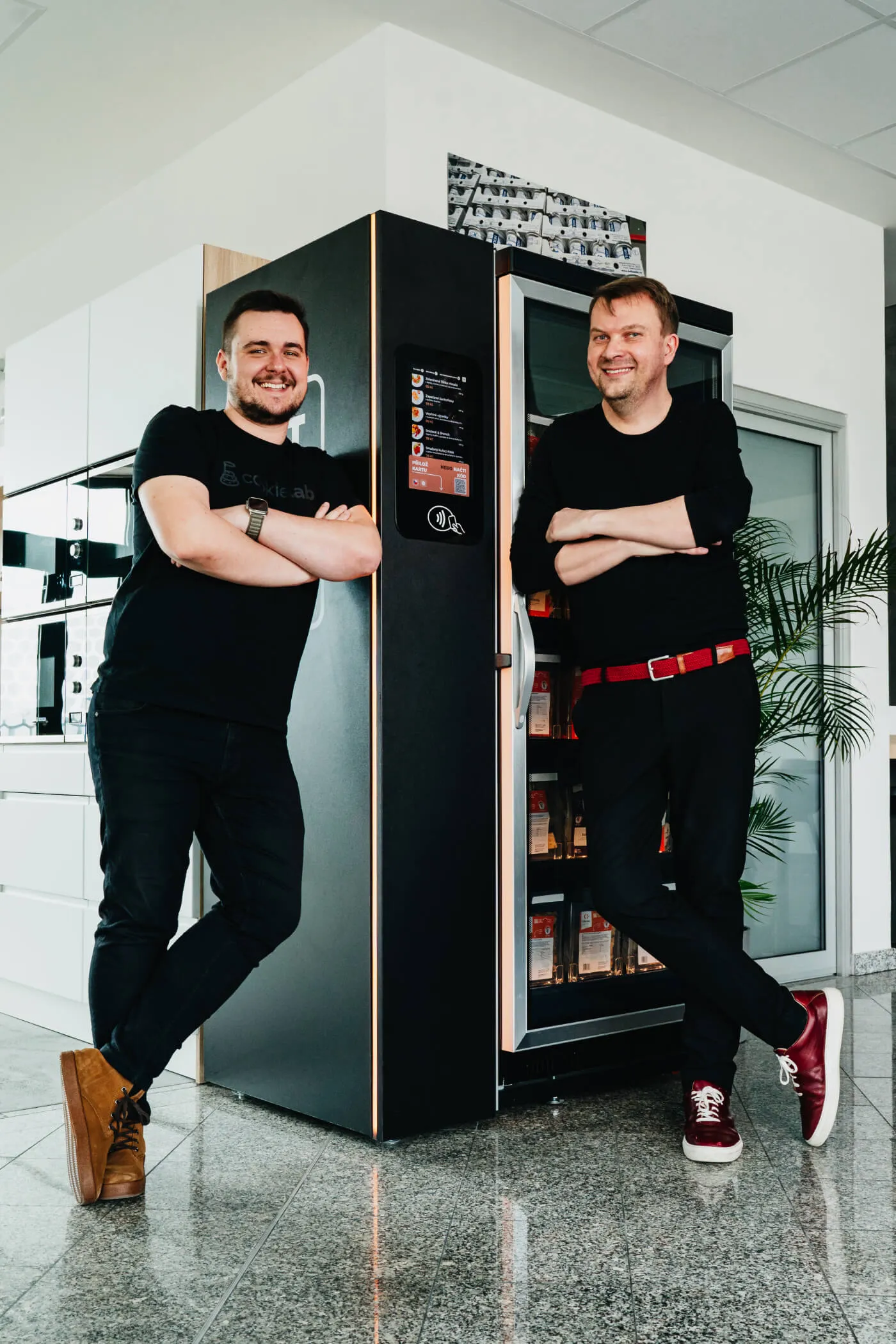
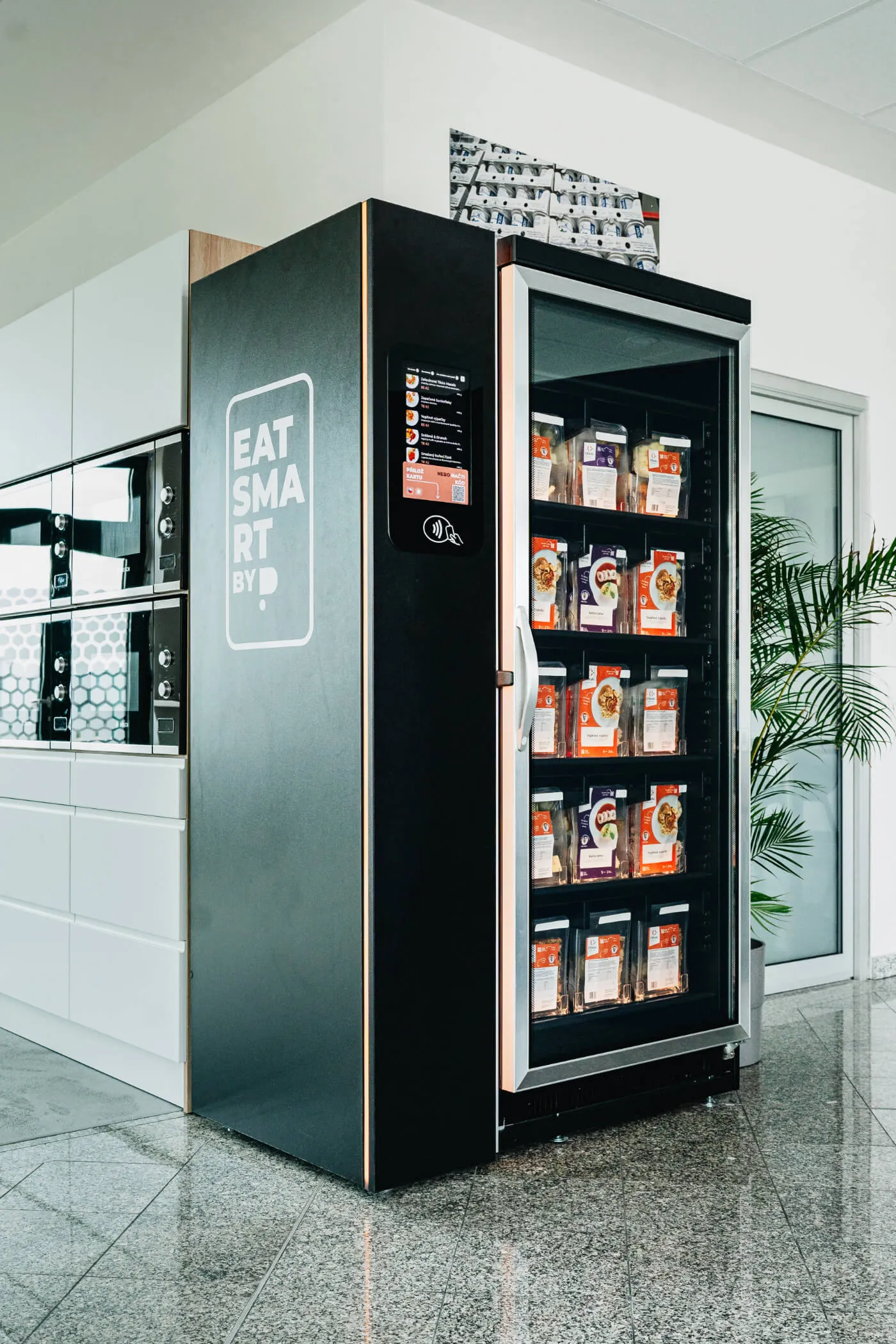
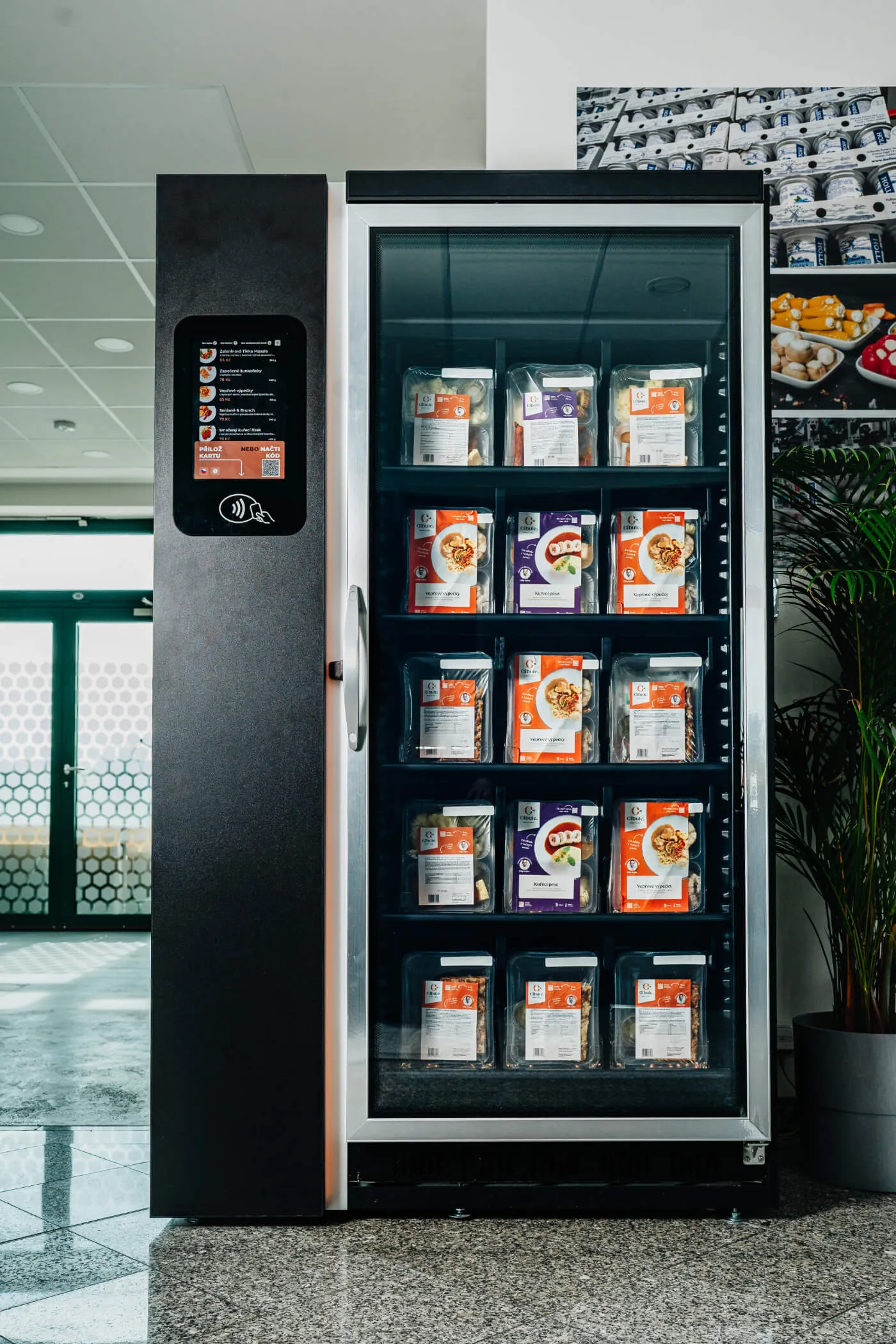
The working principle of a smart refrigerator EAT SMART
During storage, the refrigerator automatically recognizes the stored food thanks to the RFID tags placed on the boxes. At the same time, this method speeds up the service as much as possible – refilling takes only a minute and a half.
When picking up food, the employee just needs to place their employee card next to the refrigerator and it will automatically log them in. Alternatively, they can log in through the application by scanning the QR code. Users view the current menu, filter foods according to allergens, the refrigerator lights up where the selected food is located, and then it's time to eat.
The refrigerator automatically locks and sends information about the food taken to the employee and to the database. The personnel department receives instructions on how much to deduct from the employee's wages, and the supply department receives a message on how many meals are left. This whole process takes a few seconds, the slowest purchases take 15 seconds. No payment terminals are needed, and no food code punching in. Everything happens automatically.
The EAT SMART fridge also collects all gastro-specific data – monitoring the temperature and how long the door has been open. Everything is further evaluated so that people can be sure that the food is still in perfect condition.
From pilot to 80 locations
Since the January 2024 launch, we have kept expanding the product: Apple Pay and Google Pay, a credit and discount system for marketing campaigns, dynamic in-app content, remote tablet management, and tools for operations and production. The product is also getting smarter inside – an AI pipeline that enhances meal photos is already deployed, an AI agent for checking customer claims runs as a functional prototype, and demand prediction is in development.
The growth speaks plainly: around 30 locations at the end of 2024, 80 by the end of 2025, and 312,000 portions sold that year – three times the year before. Customers include WITTE Nejdek, Fehrer Bohemia, T-Mobile, and Moneta Money Bank.
What's next: 160 fridges and smarter operations
EAT SMART is heading beyond the Czech Republic and plans to roughly double the network to 160 fridges in 2026. On our side, we are working on AI demand prediction that should cut write-offs of uncollected meals, and on further simplifying the day-to-day operations of the network.

From an engineering perspective, EAT SMART is a distributed IoT system where edge computing, RFID hardware, mobile payments, and cloud meet. Every fridge is effectively a standalone point of sale that has to keep selling through connectivity outages and know precisely what a customer took. That means solving problems a typical app never hits: radio interference from metal, syncing edge transactions to the cloud, and managing a fleet of devices in the field.
What we delivered
“EAT SMART is a project where software meets the real world – metal, cold, radio waves, and hungry people. Exactly the kind of challenge we enjoy.”
Product Discovery and proof of concept
We first threw ourselves into the Product Discovery phase, where we defined the product problem, development priorities, and the future roadmap. With EAT SMART, we needed to present a working proof of concept to management within three months, while validating whether the hardware and software solution was feasible at all.
The alpha and omega was to create a system that allowed purchases to happen as quickly as possible and without a payment terminal. We assembled a wooden prototype, set up communication between individual IoT elements, and developed the application.
The Technologies
Hardware and edge
- RFID UHF
- FEIG controller
- LOCFIELD antennas
- AWS Greengrass
Cloud, apps, and operations
- AWS IoT Core
- AWS Lambda
- Node.js / TypeScript
- Native iOS & Android
- React
- Retool
Under the hood: A distributed IoT system
The architecture stands on AWS IoT. Each fridge runs as an edge node on AWS Greengrass with application logic in Node.js and TypeScript, so detecting a pickup and opening a transaction works locally even without a stable connection, and data syncs to the cloud afterwards. Above it, AWS IoT Core and Lambda process transactions, stock levels, and telemetry such as temperature and door state.
RFID: A collision with the laws of physics
RFID is the heart of the experience. Every box carries a UHF chip; when the door closes, the fridge reads what is left and derives what was taken from the difference. Reliable reading cost us a complete rework of the antenna array – metal reflected and attenuated the signal, graphite in the black paint turned out to be electrically conductive, and adhesives caused interference. LOCFIELD UHF antennas with a FEIG controller finally solved it. The pilot added one more lesson: the people who cook and pack the meals are part of the system, because a tag placed wrong is a tag the antenna cannot read.

Mobile and operations
The mobile app is native iOS and Android; the on-fridge terminal is a React webview in kiosk mode, managed remotely via MDM. The operations team runs on Retool tools for restocking, monitoring, and fixing transactions without a developer.
AI and automation
AI and automation enter the project in two ways: in the product and in how we build it. Deployed today: the automated image-enhancement pipeline for meal photos and ChefTech's real-time error detection on the production line. A functional prototype: an AI agent for checking customer claims. In development: ML demand prediction to minimize meal write-offs. In our own workflow, automated code reviews with CodeRabbit and Claude Code keep delivery fast on a long-running codebase.
What's next
We are working on AI demand prediction to cut write-offs and continuing work on the claims-checking prototype. In parallel, we are optimizing fridge hardware costs during the move to a new supplier and preparing the platform for a network of around 160 fridges in 2026.