Ravineo: From AI prototype to a platform analysing millions of posts daily
We built the MVP and production platform for Ravineo - Jan Řežáb's startup analysing millions of social posts daily and bringing transparency to influencer marketing.
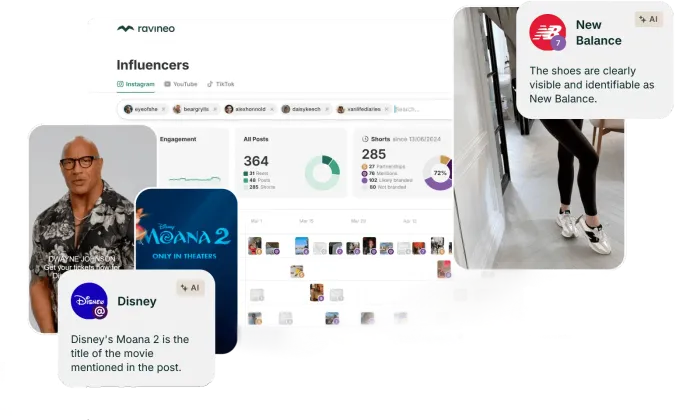
Ravineo is a Czech startup bringing transparency to digital marketing. Its analytics platform helps brands and agencies understand who talks about them on social media, in what context, with what sentiment, and whether a mention is organic or a paid partnership. Behind it stands Jan Řežáb, founder of Socialbakers (now Emplifi), back in digital marketing with a new product. We joined as the product and technology partner - first to prove the idea was feasible, then to build the platform around it.
“We've been working with Martin and Cookielab on yet another project, and we know what to expect from each other.”
The story
Brands invest millions into influencer marketing but have limited visibility into who actually promotes their products. Influencers collaborate with competitors without anyone noticing, and a large share of paid partnerships go unmarked - which is not only unethical, but in many countries directly illegal. Classic monitoring tools track mostly text, yet most of today's content is video, reels, stories and images. That is where the important things happen.
Ravineo wanted to see more: recognise a brand on a product, hear a mention in the middle of a make-up tutorial, catch a familiar jingle in a TikTok reel, and understand the context and sentiment of the partnership. Within a few weeks we put together an MVP and proved the AI could deliver meaningful analyses. It worked. Marketers suddenly had a cross-platform timeline of mentions, per-influencer analysis, detection of unmarked collaborations, and sentiment scoring - data usable for decisions on campaigns, partners, and risk.
In its first 7 months, Ravineo grew to over $2M ARR and 100 enterprise customers, including brands like IKEA, McDonald's and Samsung.
The challenges
The riskiest decision was not technical. The temptation was to build a full platform straight away; instead we first had to prove that AI analysis of real social content was accurate enough for marketers to trust. And even a validated sample guarantees nothing - a system that works on hundreds of posts can be economically unsustainable at millions per day. So we validated first, scaled second, and treated the cost per analysed post as a product feature from day one.
What's next
Honza and our team have known each other since Socialbakers. Teams work side by side and regularly join our learning sessions and hackathons. Two years after launch, Ravineo is on track to become one of the largest Czech startups in record time - and we keep evolving the product together based on user feedback.
Ravineo is an AI-first SaaS product built on multimodal analysis of social media content. The hard part was never wiring up an AI model. It was designing a workflow that handles a high volume of videos and images, keeps costs under control, and lets the team continuously test output quality while the models keep changing underneath it.
What we delivered
“The hardest part was not calling the AI. It was building a product workflow around it that delivers stable results, scales, does not cost a fortune, and can be tested continuously, because models change faster than the classic parts of software.”
Technologies
The story
We saw three risks from the start. A product risk: building too much system before validating that AI output quality was good enough. An operational risk: even a working sample may not be economically or technically sustainable at millions of posts daily. And a qualitative risk: marketing analytics cannot live with just some answer - results have to be accurate, consistent and explainable, or users stop trusting them.
The pipeline works with video, images, audio, OCR, transcription, translation and metadata. Outputs are never free text: every response is constrained by a structured JSON schema so results can be stored, filtered, compared and rendered in the product. Media and metadata are prepared in Google Cloud Storage and BigQuery, sent to batch inference on Vertex AI with Gemini models, and results land back in BigQuery for aggregation. Google Cloud Workflows and Scheduler orchestrate the whole flow.
Batch inference is the default - batches of roughly 15,000 prompts distributed across datacenters, with an on-demand path for fresh analyses requested from the UI. A fixed test set of posts lets us compare models and prompt versions and run regression checks before any model change. Token costs are optimized on every level: model selection, prompt structure prepared for caching, low-resolution video mode, frame sampling frequency, and optional fields that shorten the output schema. The trade-off we accepted is partial vendor lock-in on Google Cloud; testability and prompt versioning keep the exit door open. In production, the workflow runs roughly 6 million prompts every 4 weeks.
What's next
The AI can be very sensitive - it catches a brief logo in the background of a video, which is a strength of the product and a source of false positives at the same time. Refining the classification of exposure type, detection reason and context stays on the roadmap, alongside testing new Gemini generations, tuning context caching, shortening prompts, and adjusting the video sampling strategy. In a product like this, the model is a living dependency with its own life cycle, not a one-off integration.